
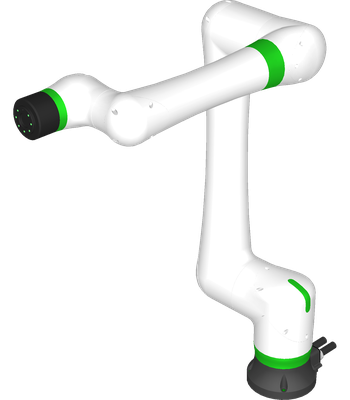
Collaborative robots, or cobots, are transforming modern manufacturing by enabling safe, efficient, and flexible human-robot collaboration. Unlike traditional industrial robots, cobots are designed to operate alongside human operators, supporting production tasks without the need for extensive safety barriers in many applications.
Their compact design, intelligent control, and ease of programming make them ideal for production environments that require adaptability, precision, and fast deployment. By assisting with repetitive, manual, or ergonomically demanding tasks, cobots help manufacturers increase productivity, improve consistency, and create safer, more efficient workflows.
Technical Applications
Ideal for handling small parts and repetitive tasks, cobots improve speed, accuracy, and consistency across manufacturing lines.
By streamlining packaging and palletizing processes, cobots help improve efficiency while adapting easily to changing production requirements.
Equipped with vision systems, cobots can detect defects, sort products, and support compliance with quality and safety standards.
By automating the loading and unloading of machines, cobots help optimize workflows, reduce downtime, and improve overall production continuity.
Applications & Grades
They are a base material in applications that do not require any formability beyond minimal bending and/or roll-forming.
- Large and Small Electric Motors
- Generators
- Ballasts
- Transformers
